
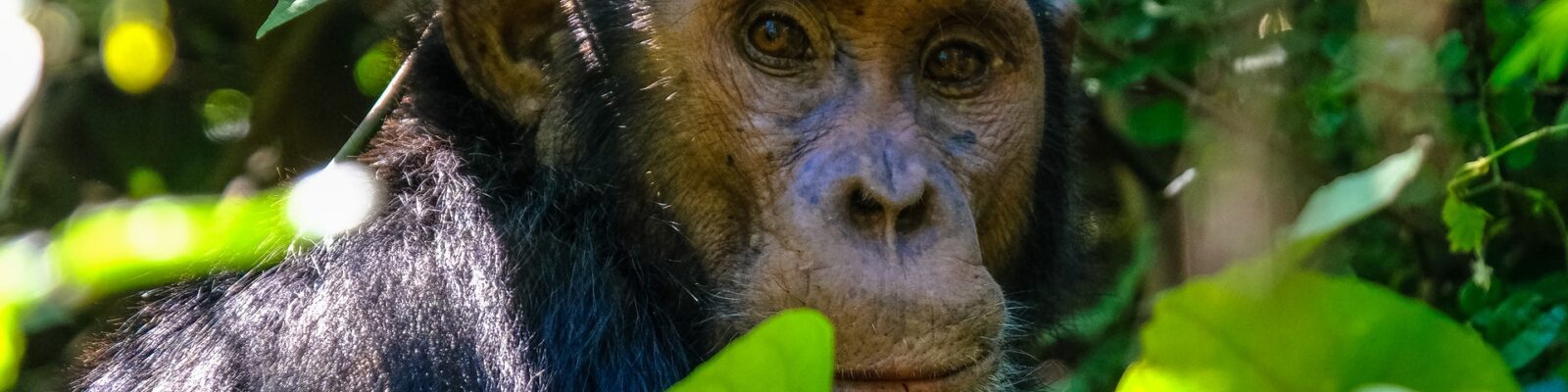
Interestingly, chimpanzees are amazing creatures worth interacting with in Africa, sharing up to 98% of their DNA with humans. On a chimpanzee tracking safari, there are a number of things tourists get to explore about chimpanzees including how they feed or their feeding habits. Chimpanzee diet is composed of many things but most importantly, they are largely herbivorous.
Chimpanzees often feed on leaves, fruits, seeds, nuts, flowers, plants, mushrooms and little of insects and many more. A large percentage of chimpanzee diet is composed of fruits about 59.4%, leaves 21%, seeds 5.1% and meat 1.4% among others. At times, chimpanzees prepare their food prior feeding on them for instance fruits, they can chew to make small balls also referred to as Wadges. They dip little balls into the water prior to sucking the juice.
Nuts are often broken using stones / branches that serve as a hammer/anvil. They put nuts on a hard surface like a tree root and hit it using a stone. When harvesting insects, they make the best use of sticks and keep tapping the ants/termites. With such creative minds, chimpanzees are without doubt a few most intelligent creatures on earth, after human beings.
In a chimpanzee habitat, figs make up about half of these great apes’ diet. They are not only nutritious or delicious but they are a major source of energy. Remember, they need a lot of energy considering a fact that they spend their long day moving in search of what to feed on and so much more.
Fruits vary and usually, chimpanzees feed on apples, bananas, mangoes and more. When it is a low season of fruits, they don’t import and only depend on what is available in the area they dwell in, which is a bit different with humans.
Nuts, seeds make up part of chimpanzees’ diet – feeding mostly on oil palm nuts. Besides, chimpanzees also depend on panda / kola nuts.
Leaves are the alternative diet for chimpanzees especially during scarcity of fruits. They depend on different kinds of leaves, tree barks, seeds, flowers and more. Also, insects account for a significant percentage of chimpanzee diet. Often, chimpanzees have been observed eating termites and they harvest them using small tools.
Chimpanzees also love honey and interestingly, they have different ways of harvesting it- they dip sticks into the nests or use force. Meat and eggs – there are some discoveries that chimpanzees do hunt for and eat meat, though sometimes they depend on mainly vegetation.
Chimpanzees have been observed hunting for small antelopes like duikers, monkeys such as the red colobus monkeys, baboons and red tailed monkeys. They can chase, block the prey or just ambush, unlike their counterparts bonobos that hunt less.
Like humans, chimpanzees also know several plants that are of medicinal importance. They have been spotted feeding on Aspilia mossambicensis. Aspilia is an important plant they use for getting rid of parasites in their digestive system.
How much do chimps eat per day?
Chimpanzees spend most of their day eating, walking up to 4kms. In a full day, chimpanzees feed 2 times and they prefer certain types of leaves due to their richness in nutrients.
Where to find wild chimpanzees?
Africa is the only home to wild chimpanzees and they are distributed in different parts of the continent. Popular places often visited by tourists for chimpanzee trekking include Uganda (Kibale National Park, Kalinzu Forest, Budongo, Semuliki Wildlife Reserve and Kyambura Gorge); Rwanda in Nyungwe Forest National Park and Gishwati-Mukura National Park; Tanzania in Mahale Mountains National Park and Gombe National Park.


