
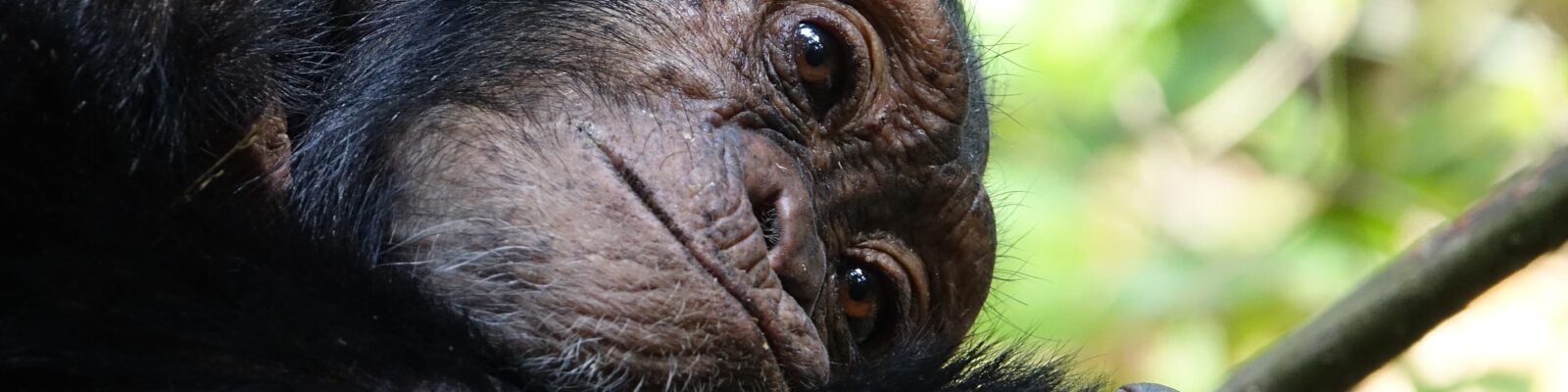
Chimpanzees are arguably the closest human relatives in the wild; however, they are distinct on their own way. Chimpanzees / Pan Troglodytes also often referred to as chimps are great ape members together with the bonobos, gorillas, orangutans and humans. Over 98.7 percent of chimpanzees’ genetic DNA is similar to that of humans.
Size of chimpanzees.
Chimpanzees are considerably bigger than the bonobos with a fully grown up adult chimp weighing from 40 to 70kgs and females 27 to 50kgs. In average, chimps can stand upright 120-150cm though others can stand 168cm on their legs and weighing 138kgs.
Strength of chimpanzees.
Chimpanzees are more robust than their counterparts – the bonobo. They have robustly built arms longer than the legs. The arms can reach below their knees with longer fingers but short thumbs. They also have flat fingernails with feet made distinctly with capability to grasp. A fully grown adult chimp’s grip strength is about 200kgs and others are believed to be over 330kgs.
Though humans have a lot in common with these great apes, they differ significantly from us in some aspects. Chimpanzees have a unique style of climbing trees supported by their robustly built arms. They knuckle walk and stronger than humans about 5-8 times. Chimpanzees’ physical strength is about 1-2 times compared to humans and this is attributed to their higher content of fast twitch muscle fibres. This is one of their unique adaptations for swinging or climbing trees.
Chimpanzee sub-species.
There are 4 sub-species of chimpanzees currently recognized with the 5th still being debated. They include the Central chimpanzees / tchego – this thrives mainly in Central African Republic, Cameroon, Gabon, Equatorial Guinea, D.R. Congo and Republic of the Congo. Over 140,000 of Central chimpanzees still exist on earth.
Western chimpanzees. These sub-species of chimpanzees live in most parts of Senegal, Mali, Liberia, Guinea-Bissau, Ghana and Sierra Leone. An estimate of 52,800 of Western chimpanzees still live in Africa.
Nigeria – Cameroon chimpanzees. These live in the lush forests of Cameroon and Nigeria. About 6000 to 9000 of this sub-specie still thrives.
Eastern chimpanzees. Considerably, the most sought after sub-species of chimps in Africa. The Eastern chimpanzees live in South Sudan, Central African Republic, D.R. Congo, Rwanda, Tanzania, Uganda, Burundi and Zambia. The Eastern chimps remain not more than 180000 to 256000 in the wild.
Chimpanzees are notably a few most adaptable creatures. They range in different habitats in Africa. They can be spotted in montane forests, evergreen rainforests, dry savanna and dry Woodland-Savanna mosaic to swamp forest. In Tanzania, they live in Gombe stream National Park, an area with semi-deciduous and evergreen forest, open woodland.
Other features of chimpanzees.
Chimpanzees, like most Great Apes have most of their bodies covered with hair. However, their palms, toes, fingers and face are plain with no hair. As they continue aging, they lose much of their hair and become bold. They grow black hair though they can also have brown hair and when they age, they develop a grey patch on the back.
During oestrus, females develop swelling pink skin. Humans and chimpanzees have almost the same gestation period, with female chimps taking 8-9 months. However, they produce a single baby and very rare do they give birth to twins or triplets just like human beings. They live in communities and in each community, there are 20-150 members.
Chimpanzee diet.
Chimpanzees prefer feeding on vegetation – fruits, leaves, seeds, barks, stems, blossoms and more. Over 64.5% of the time chimps is spent feeding on fruits and over 84.5% of the fruits are ripe. They are also known to prey some mammals including the red tailed monkeys, blue duikers, western red colobus monkeys, bush babies, yellow baboons and others.


